Here’s a look at six stages of Quincy’s granite life over the last 250 years.
1. Dragged
The early colonists of Braintree (only later did Quincy separate from Braintree) used “sheer poles” with a team of oxen to move the heavy granite stones and boulders they found on the surface of the ground.

To construct “the “sheer-pole” colonists firmly bound two long, heavy, equal length poles at the upper end. Then they drew the lower ends apart to make them stand steadily. Guys front and back held the legs upright. They fastened a luff-tackle …
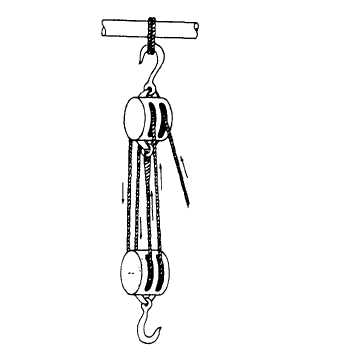
…to the top where the poles joined together, and brought it down and attached it to the stone to be raised. They hitched a pair of oxen to one end of this lifting rope and they pulled the rope and hence the stone. “This method, much easier than that of rolling them [granite stones] upon sticks of timber, by hand-power alone, was, nevertheless, extremely difficult and tedious…” p. 390 History of Milton op. cit.
They would lift the stone and pivot it forward and repeat. This animation from TitanicDock and Awakin shows how it works.
Colonists of this time in the 1700’s “worked with loose boulders, using heat to crack the stone. They built a fire on top of a large stone and then dropped a heavy iron ball to split it. Stonemasons would further break the heated rock with sledges. …” – from “Lessons in Stone”, Harvard Magazine, Nov, 1997
As the following sketch, from an 1852 wood engraving by Richard P. Mallory of the Quincy Granite Quarries of Whitcher and Sheldon, shows …

… teams of oxen and sheer pole lifting methods remained in use, some 100 years after scene pictured in the “History of Milton” above.
However the workers hammering and drilling in the foreground of this engraving are using a “revolutionary” new technique…
2. Split
From Harvard Magazine,
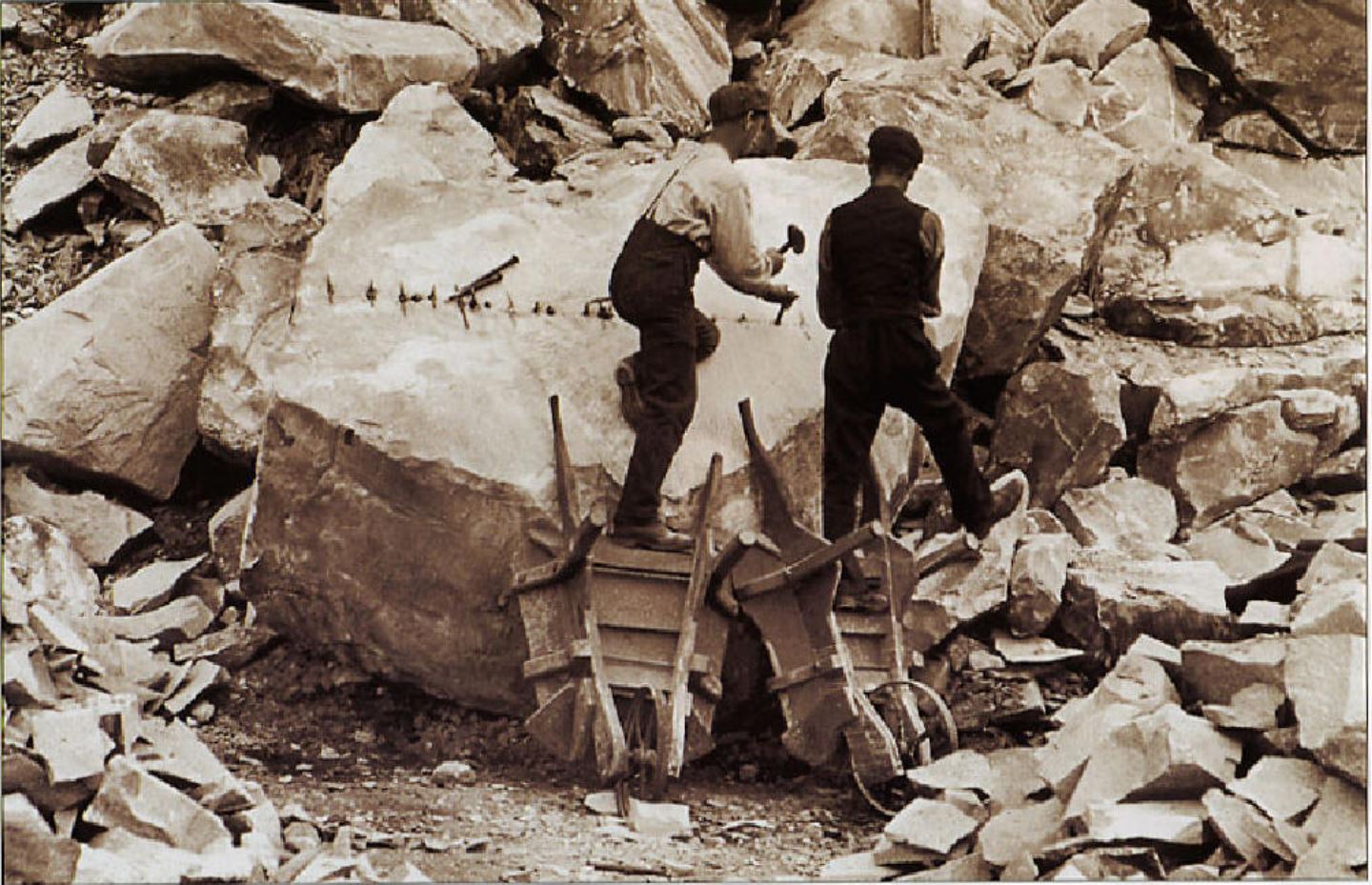
Bulfinch, A.B. 1781, is often credited with helping to start Boston’s early-nineteenth-century granite building boom. His desire in 1802 to use granite for a new prison in Charlestown inadvertently led to the introduction of an improved method for cutting stone. Until then, stonecutters rarely quarried rock; instead they worked with loose boulders, using heat to crack the stone. They built a fire on top of a large stone and then dropped a heavy iron ball to split it. Stonemasons would further break the heated rock with sledges. To create square pieces, they cut a groove into the surface with a sharp-edged tool called an axhammer and then struck the rock with a heavy hammer until it fractured.
Bulfinch wanted granite for the prison, but local stone prices were too high. Lieutenant governor Edward H. Robbins, A.B. 1775, one of the prison’s commissioners, set out to locate cheaper materials. While passing through Salem, he noticed a building made of rock that had been cut in a manner new to him. After several inquiries he found a Mr. Tarbox of Danvers, who explained his method of drilling a row of holes into the rock and then pounding small wedges into the openings to split it open, creating a smooth face. Robbins was so impressed that he hired Tarbox to instruct the local stonecutters, who were so elated with this new method that “they adjourned to Newcomb’s Hotel, where they partook of a sumptuous repast,” according to William Sullivan Pattee in A History of Old Braintree and Quincy. …”
Williams, D. B. (1997, November). Lessons in Stone. Harvard Magazine.
https://www.harvardmagazine.com/sites/default/files/html/1997/11/stone2.html
Mr Keeble of Memory Lane, Heritage Village demonstrates how Feathers and a Wedge work…
This profound improvement “…dropped the price of cut stone 60 percent” and caused the use of granite in construction to soar.
Over the next 50 years, [1826 – 1876] dozens of quarries opened in Quincy, supplying granite for a building boom that stretched from New York to New Orleans. During the heyday of the industry in the mid- to late-1800s, immigrants from Scandinavia, the British Isles, and the Middle East came to work in the Quincy quarries. Many brought or acquired expertise that would provide Quincy with a wealth of skilled labor. They also shaped and enriched the character of Quincy’s neighborhoods.
Mass Humanities. (2012, November 17). Quincy’s granite industry begins.
https://www.massmoments.org/moment-details/quincys-granite-industry-begins.html

3. Exalted
Geologists explain that Quincy granite is actually Syenite (or Sienite). This not common rock differs from granite due to its absence or scarcity of quartz. Named after the ancient city of Syene in upper Egypt – present day Aswan – where stone quarries produced quality stone for the prehistoric construction of decorative monuments such as sculptures and obelisks. This high quality made Quincy granite especially attractive to builders.

The demand for Quincy granite for building construction began to wane in the twentieth century, as building styles changed and builders chose more affordable materials. The production of memorial and ornamental stone with Quincy granite did gain some momentum.
4. Dropped
The worldwide depression of the 1930’s finally stopped demand for Quincy granite and the city turned to shipbuilding…
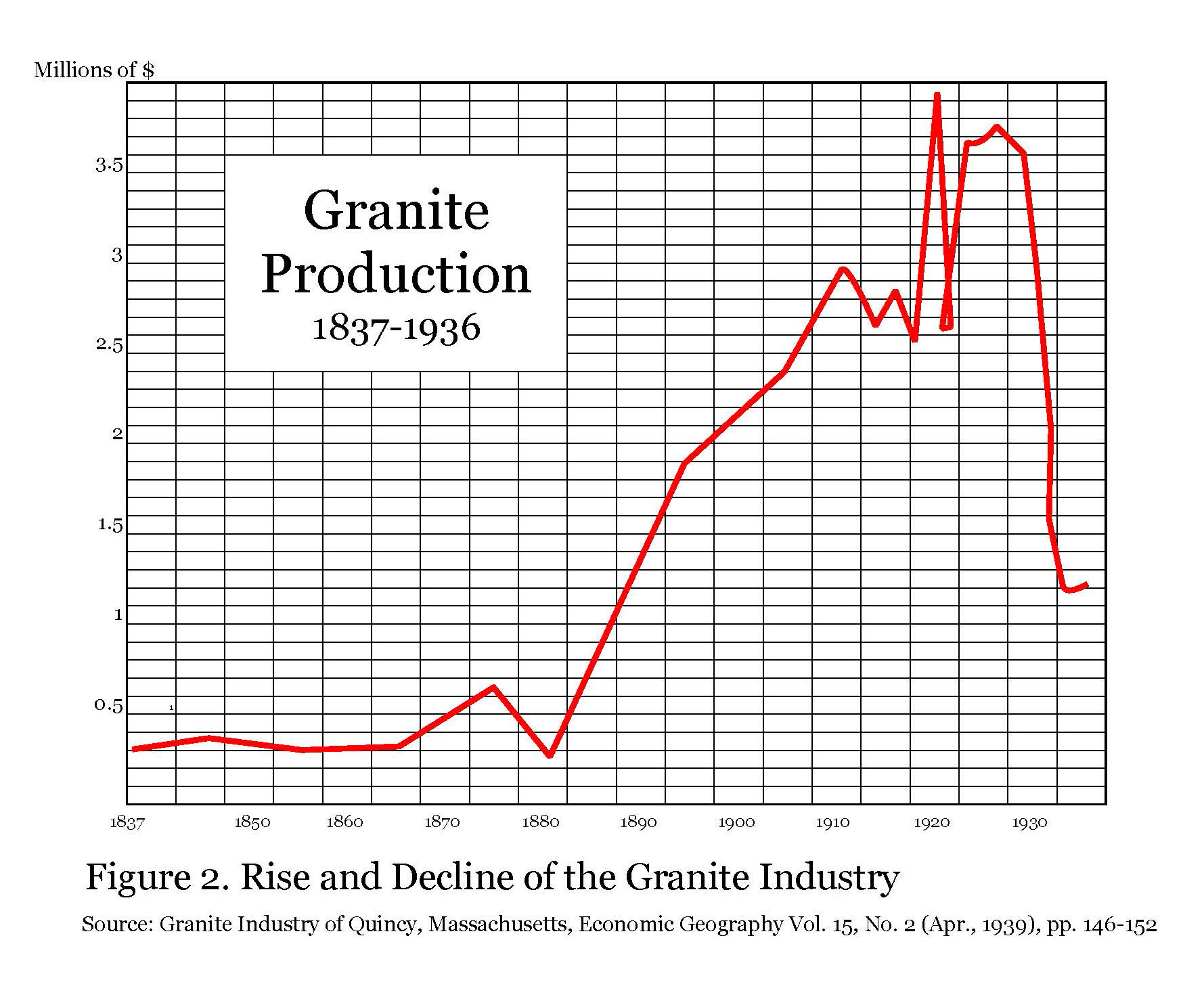
…leaving the quarries idle. And this caused problems.
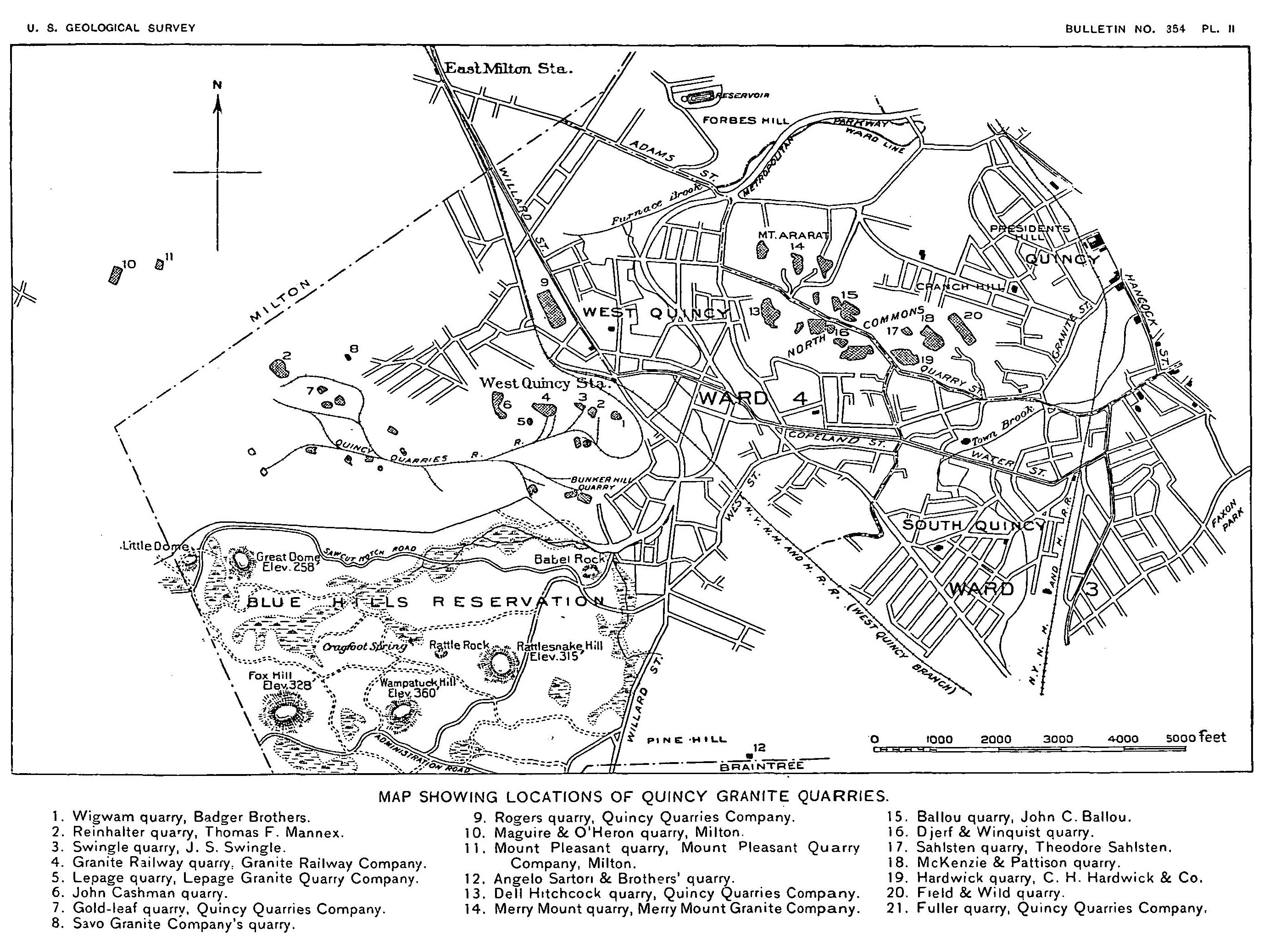
Siting and permits being what they were (or weren’t) in the early 1800’s, the Quincy quarries sprouted in an unplanned, uncoordinated fashion. American faith in free enterprise meant only limited civic oversight and many quarries of relatively small size staked spots all around the rich vein of Cyenite. Here’s a US Geological Survey map of 1906 showing over 20 separate quarries in Quincy.
Each separate quarry company cut its own quarry “holes” deep down within the space they owned. This meant very steep dangerous walls of ledge for each “hole”. The images following show the Dell Hitchcock Quarry…
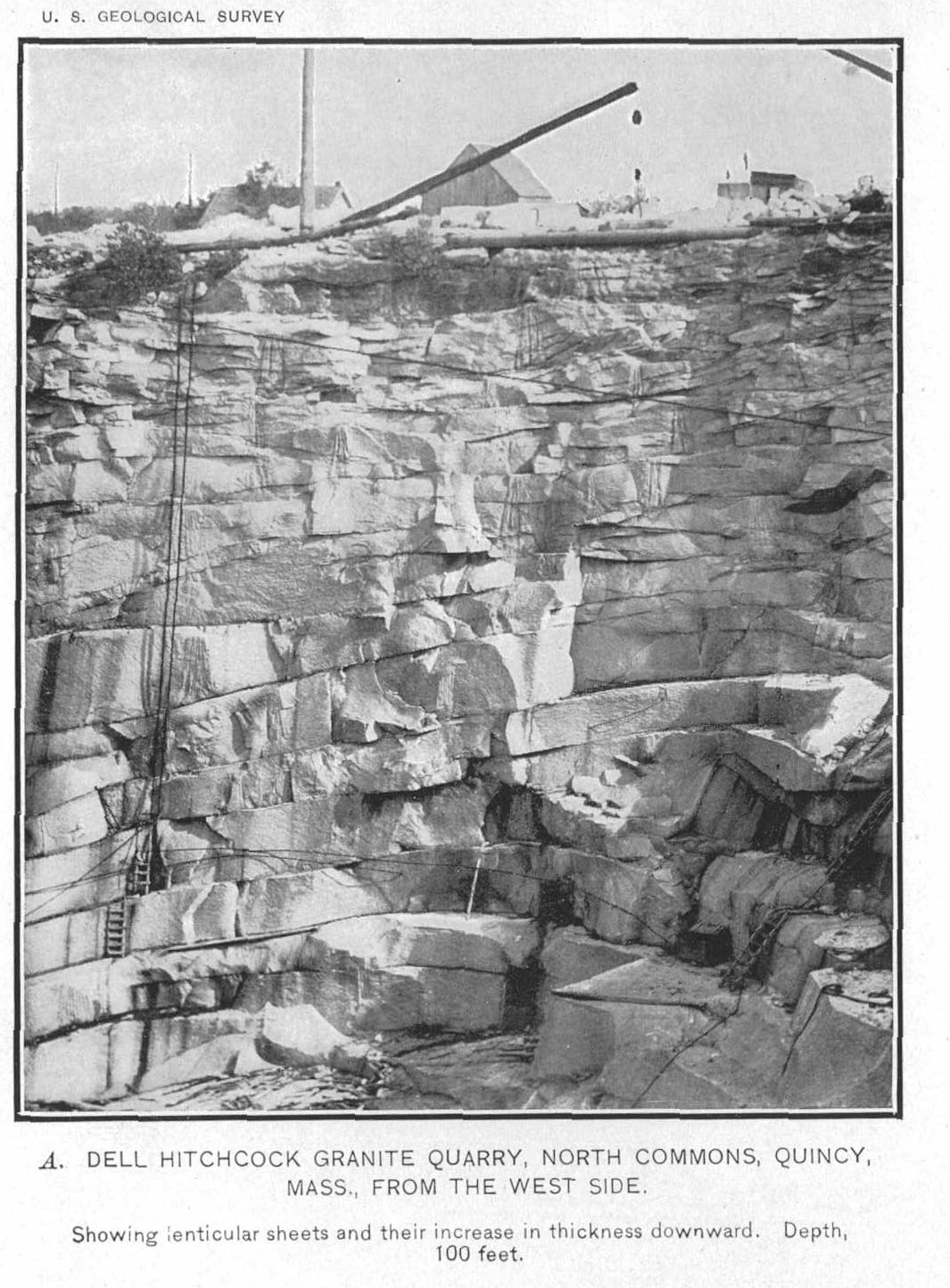
Dell Hitchcock Granite Quarry, North Commons, Quincy MA, from the west side. – Showing lenticular sheets and their increase in thickness downward. Depth, 100 feet.
…and the Swingles Quarry.
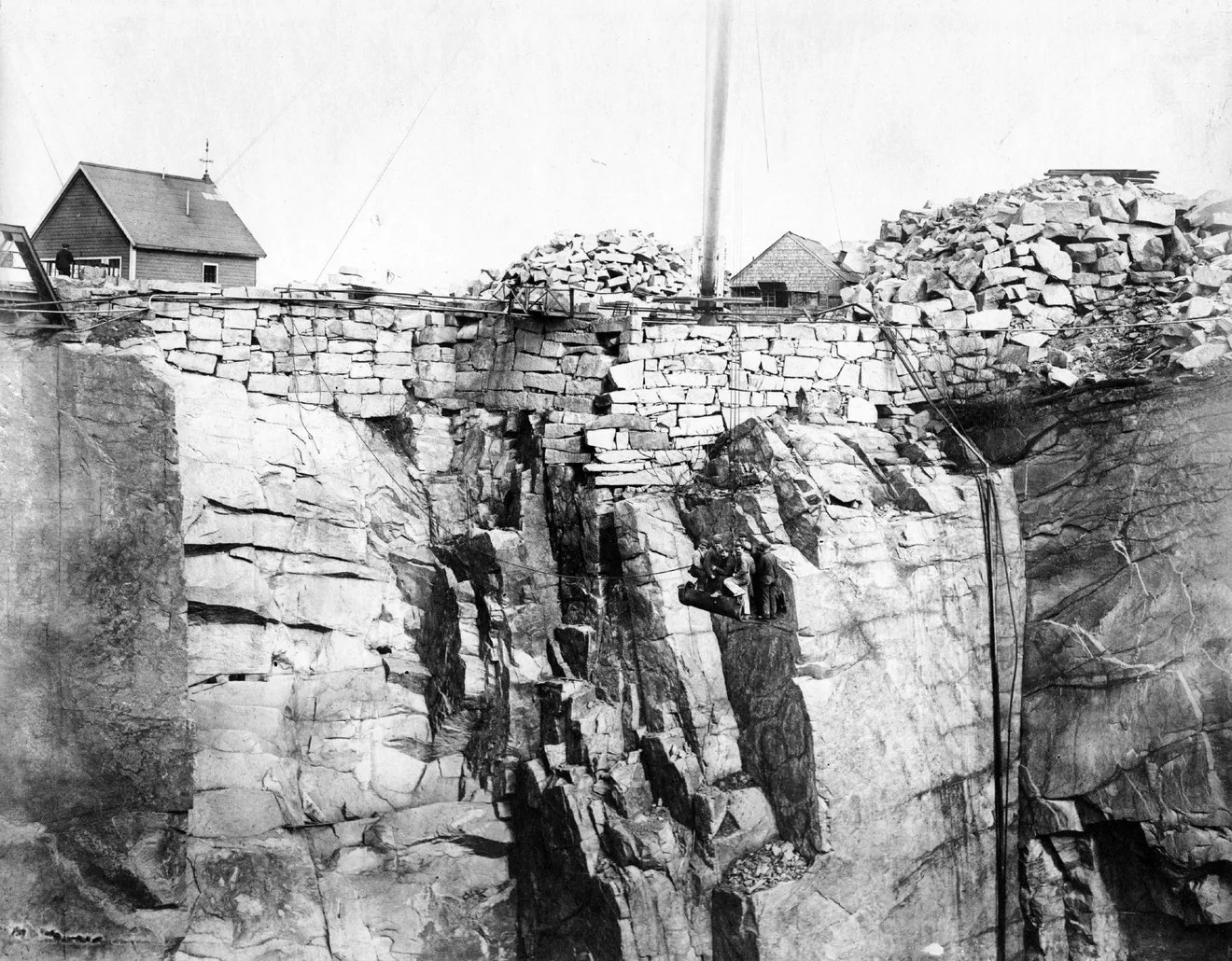
Note the aerial lift platform crowded with workers at the center.
Once idled, these separate, deep and steep hollows into the solid rock filled with rain and ground water. The flooded quarry provided thrilling spots for diving and swimming. Photographer Arthur Griffin’s pictures of Quincy Quarry divers graced the cover of Life Magazine on August 8, 1938. One of his other pictures,

After World War II, the use of concrete as a cheap substitute for quarried stone finally doomed the remaining granite operations. The last quarry in Quincy closed in 1963. The dangerous, abandoned quarries became meccas for youthful escapades some of which resulted in diving deaths and plenty of safety worries.
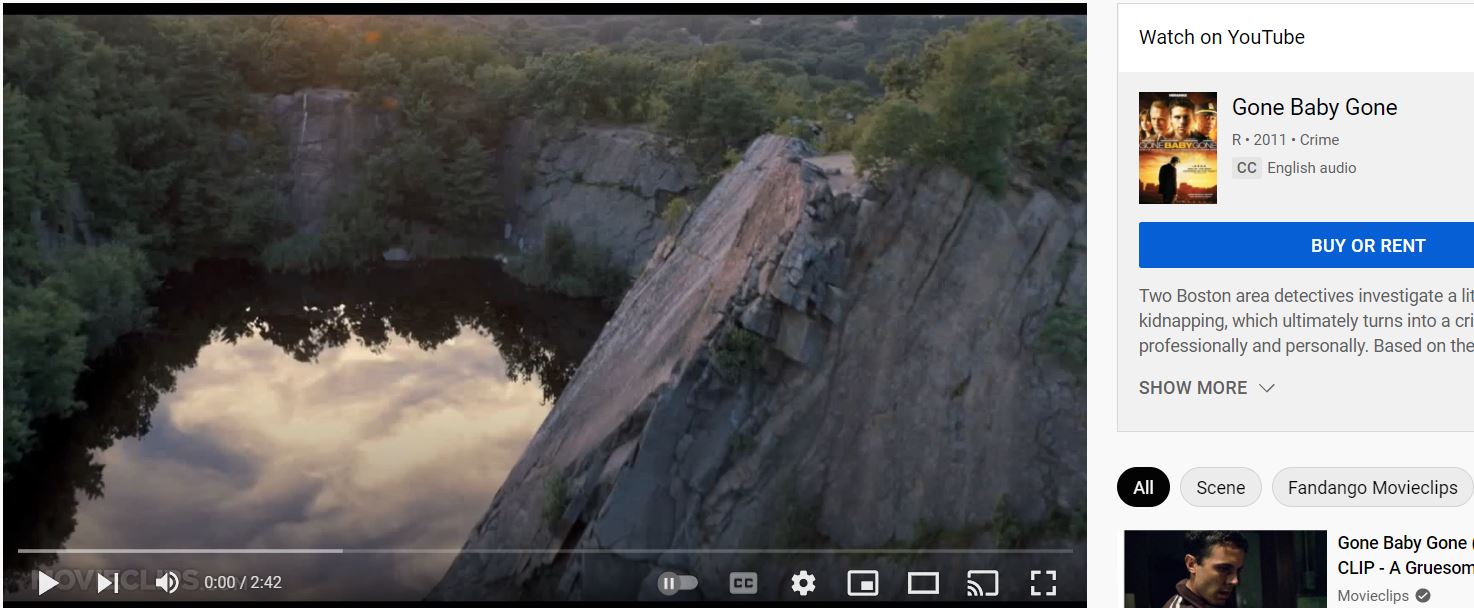
The underworld also took advantage of the quarries’ rugged remoteness as imagined by Dennis Lehane in “Gone Baby Gone” featuring the following view of the Granite Rail Quarry in the movie Directed by Ben Affleck of the same name.
The municipalities of Quincy and Milton saw abandoned quarries as a way to deal with the mountains of trash the 20th century economy was dumping on the towns. In the following 1966 Boston Globe article, the mayor and DPW chief of Quincy are looking at the quarry landfill and are assuming that, “the 21st century will dawn before all the quarry holes are filled.”
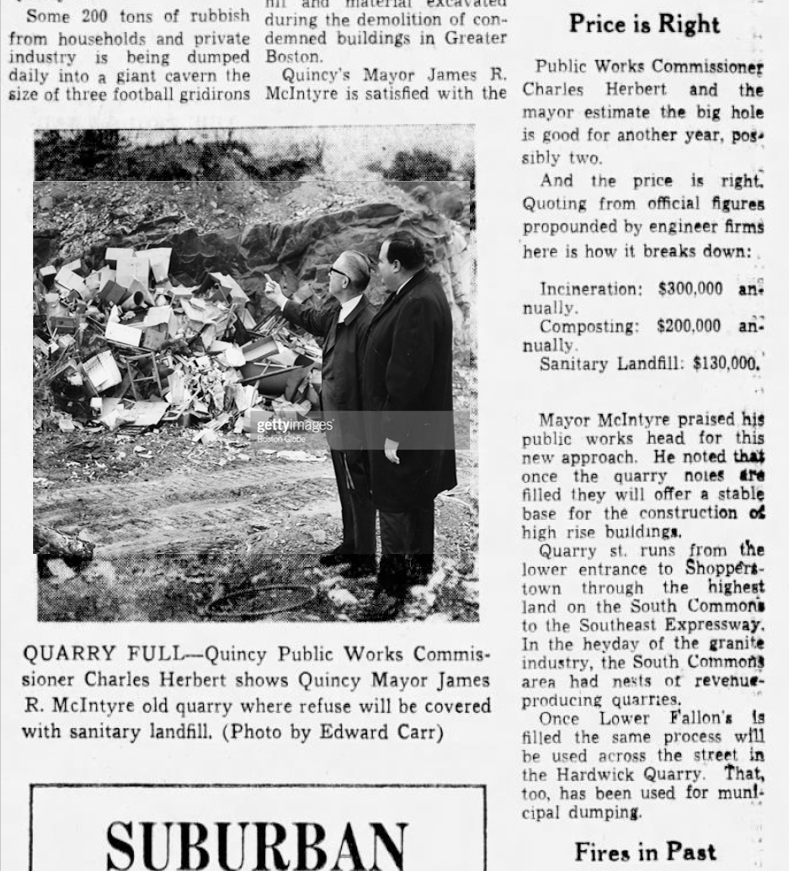
Collins, J. J. (1966, April 25). “Quincy to Fill Quarry Then Cover It Over and Build Apartments” Page 38 – The Boston Globe at Newspapers.com. https://bostonglobe.newspapers.com/image/433743252/?
But the entire scene changed when the fifth stage intersected this downward spiral.
5. Buried
John Sanford, the architect of the Granite Links Golf Course said “In this profession it was a once-in-a-lifetime opportunity. The stars had to align, and the timing had to be perfect. The project was immensely expensive, so if the dirt had not been available, the project would never have happened.” He was referring to Boston’s “Big Dig,” the state’s 15-year, $24-billion road infrastructure makeover of the central artery and airport tunnels. By making the future golf course site, and the rest of the idled quarries, a repository for the 900,000 truckloads of 13 million tons of material just seven miles from the Big Dig, construction teams could save the taxpayers’ money [they would have spent on getting rid of the fill], cap the current trash dumps, and reclaim acreage for golf and recreation activities.
All parties benefited; all parties agreed and they began the filling process.
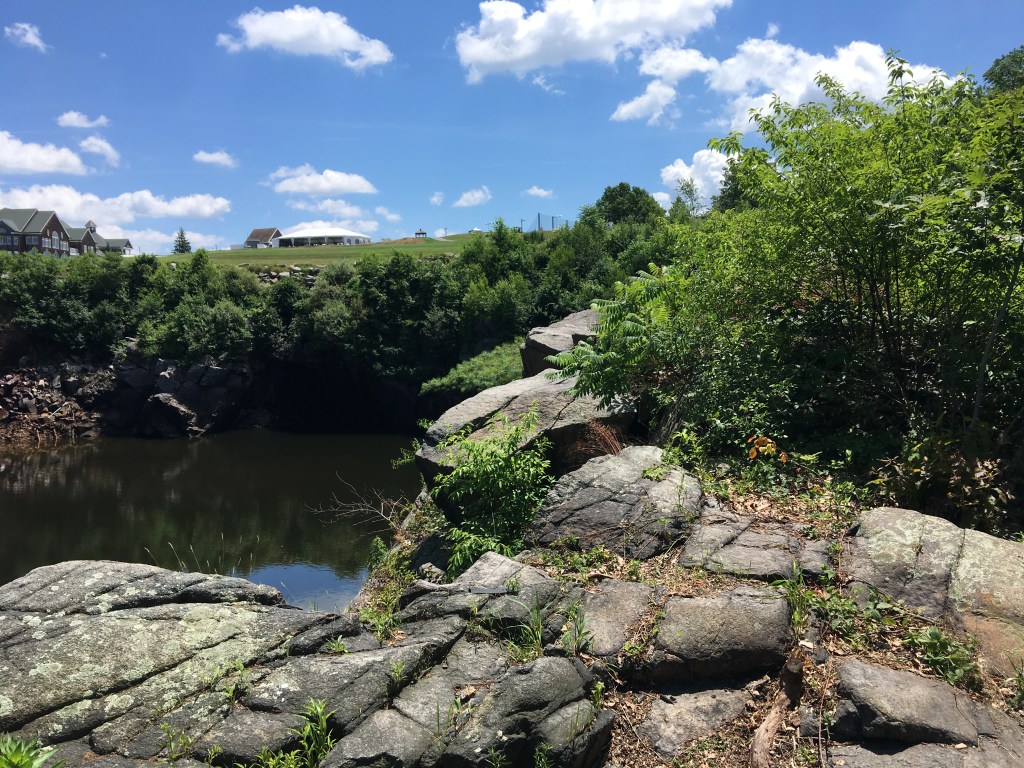
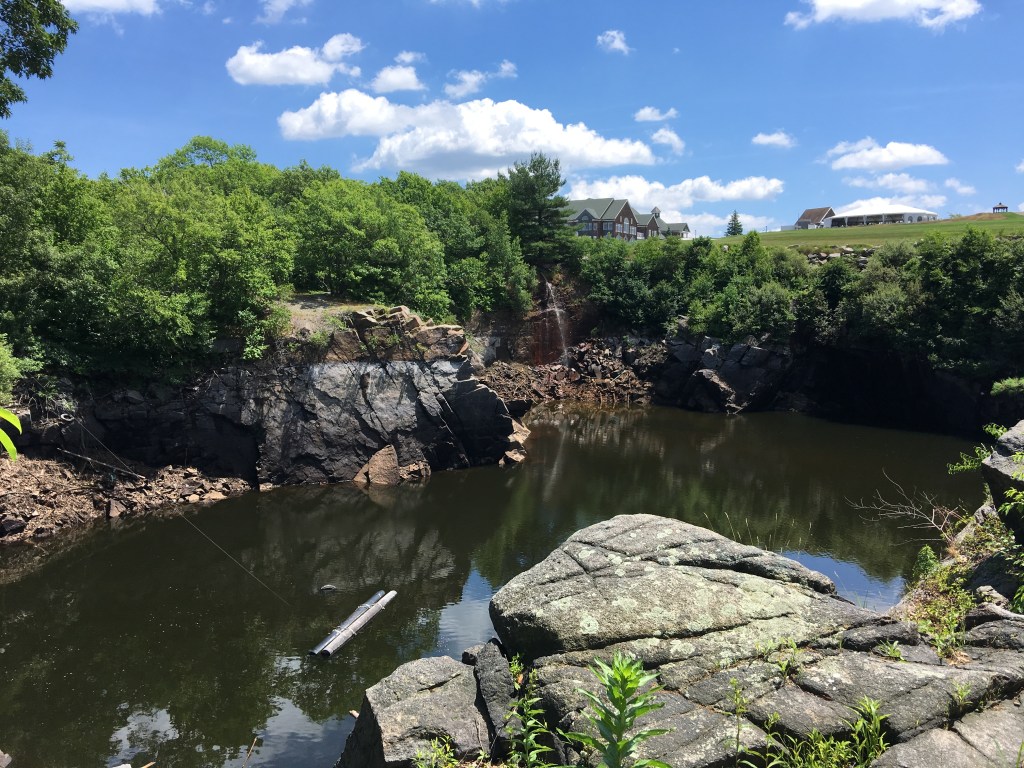
The fill from the Big Dig transformed the Granite Rail Quarry. A 200 foot cliff-drop-into-debris-and-brackish-water became a grass field with granite promontories – a climber’s delight.
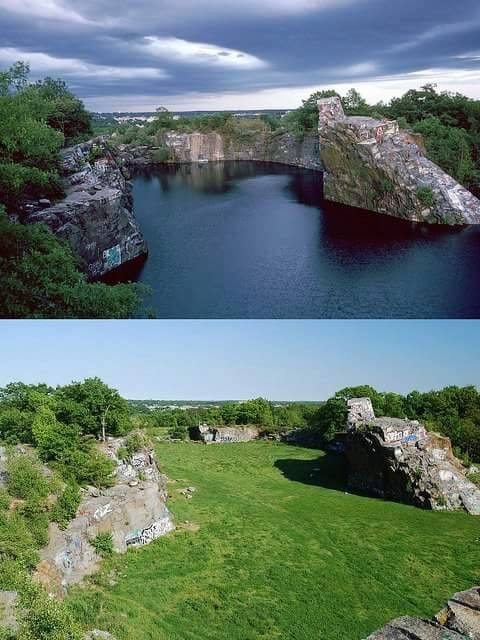
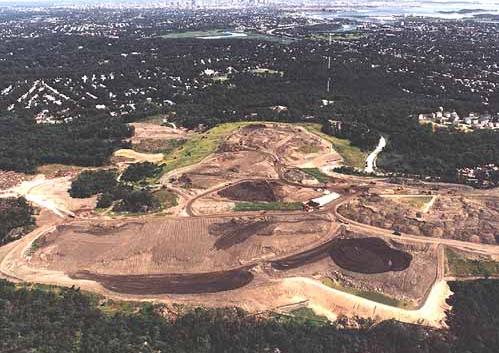
The Granite Rail quarry may seemed easy in comparison to the larger “Quarry Hills and Granite Links” effort. The many parties who began this project in 1989 faced challenge after challenge. Between landfills, old quarries and various other properties, the developers, and other stakeholders, had assembled almost 500 acres [¾ of a square mile] for the site of the complex: golf courses, apartments, etc. Two sides of this acreage abutted the Blue Hills Reservation, a protected wilderness park. Most of the abandoned quarries on the site – in addition to the Milton and Quincy landfills – had filled with rubbish and junked cars over time, and many other areas qualified as badly contaminated wetlands.
So, permitting the development of a golf course on top of this landfill—in two different communities— eventually required more than 100 permits and amendments.

Environmental law required that they “close” the landfills by capping them with specific layers and depths of material. Each of the layers had to feather into the edges of the wetlands, skirt the historic work sites, and allow the grading requirements for the features of the golf course. They had to design green complexes and other features to avoid disturbing the “seal” of the layers for drainage and irrigation systems, as well as collection of gases.
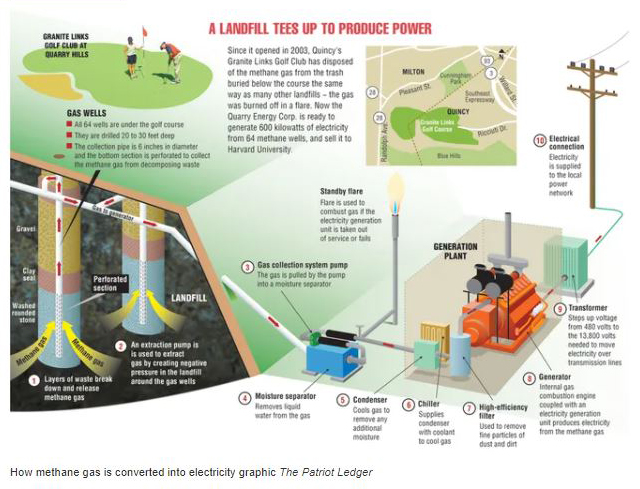
And the developers designed a means of collecting these gasses and burning them to generate electricity – a small methane power plant that contributes electricity to the grid. It converts the greenhouse gas generated by a million cubic feet of decomposing garbage into 600 kilowatts of electricity for Harvard University – enough to supply 200 homes.
6. Risen
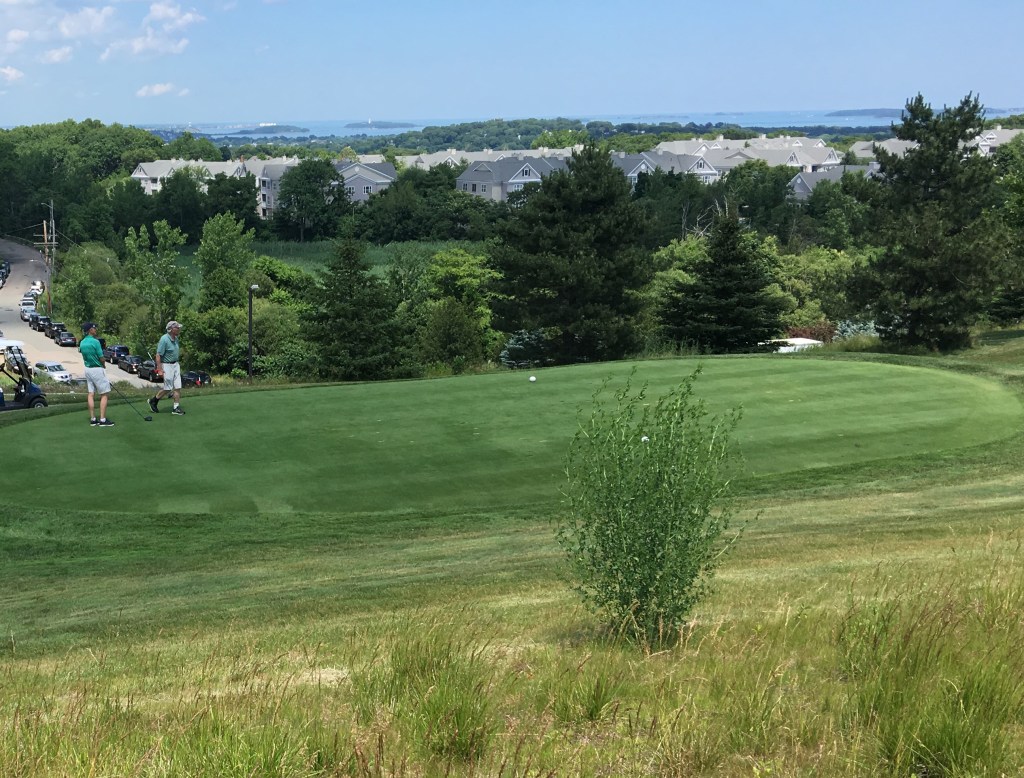
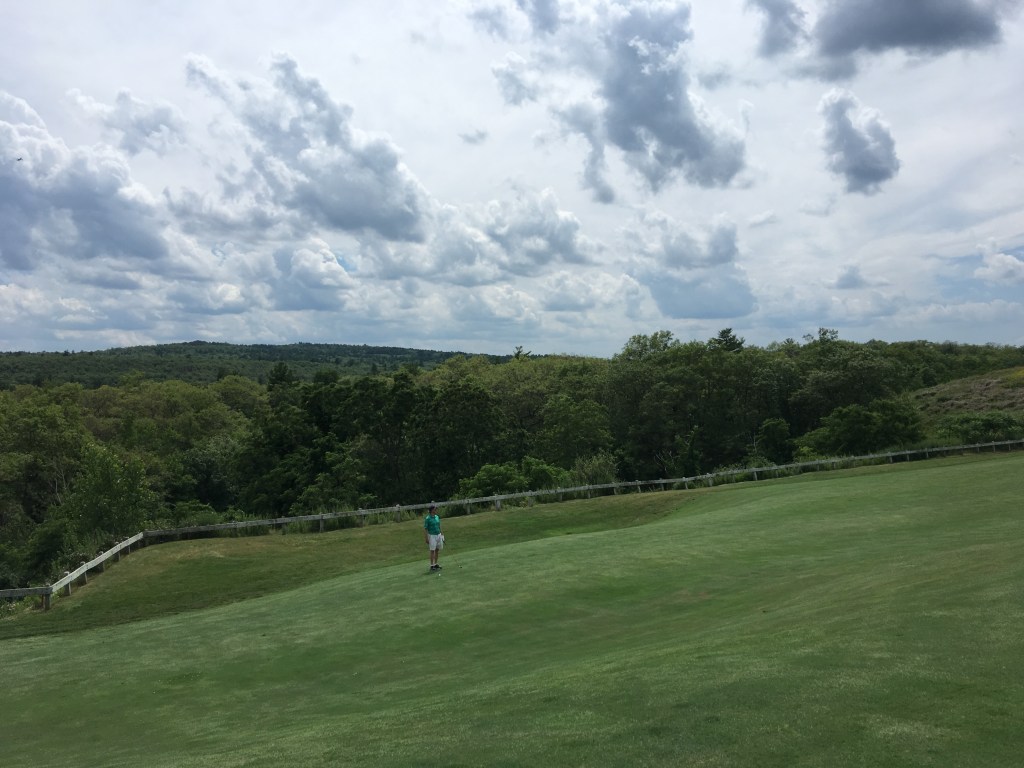
In the final stage, glory has risen. Oh the views… and the course.. and the fun… and the food and the hiking and climbing….!
From the rusting remains of cars, up the sheer granite cliff sides has risen a true landmark.

The former quarry areas of West Quincy have become the go-to destination for young, upwardly mobile people in the Boston area. And who can blame them?


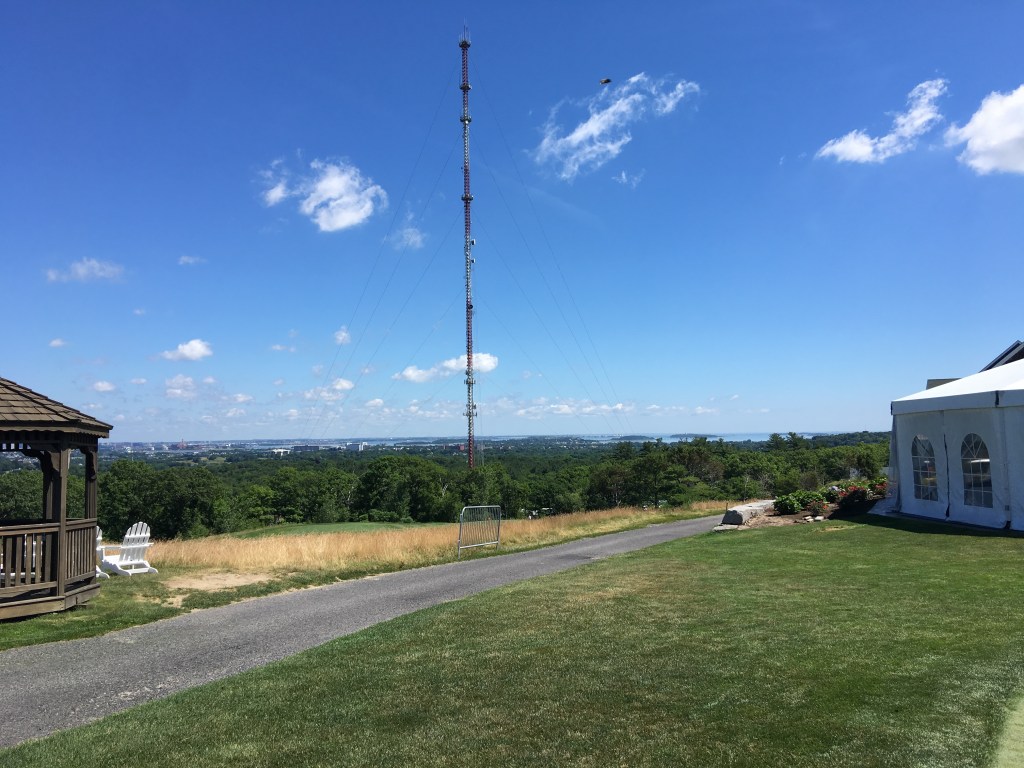
What a joy to play here.
Thanks to all that made this beautiful site.
Here is an animated version of this post:
References
1852 wood engraving art granite stone quarry mining Quincy MA miners L. (n.d.). Period Paper Historic Art LLC. Retrieved March 1, 2022, from https://www.periodpaper.com/products/1852-wood-engraving-art-granite-stone-quarry-mining-quincy-ma-miners-labor-ygp2-235362-ygp2-032
Offering of the engraving of Quincy Quarry and identification of its sourcing.
Awakin. (2012). FREE e-Book – Free interactive study guide to Titanic and Belfast’s rich maritime history. Wayback Machine – for TitanicDock.com. Retrieved March 2, 2022, from https://web.archive.org/web/20160315024524/www.titanicdock.com/news/article/titanic_island_game_free_titanic_e-book…_coming_soon/
Animation of sheer legs crane from “Chapter 2 – Key innovations, including the sheerlegs crane and the Alexandra Dock”
Bonomo, T. (2013). The Quincy Quarry Rail Road 1893-1918. The Quincy Quarry and Granite Workers Museum. Retrieved March 8, 2022, from https://www.quincyquarrymuseum.org/uploads/1/1/9/7/1197301/the_quincy_quarry_railroad_story_1.pdf
includes map of quarries
Branch, E. W. (1907, May). 1907 Norfolk County, Massachusetts, Quincy quarries company, copy plat atlas map. eBay. Retrieved March 8, 2022, from https://www.ebay.com/itm/232579599698#vi-desc-maincntr
Ernest W. Branch 1907 Plat Atlas map of the city of Quincy in Norfolk County, Massachusetts. It includes the Quincy Quarries Company and Quincy Station. I Plate 30: covers from Grove St. to Blue Hills Reservation and to Willard St.
Central artery / Tunnel (CA/T) construction – Jay Cashman, Inc. (2018, January 28). Jay Cashman, Inc. Official Website. https://www.jaycashman.com/work/central-artery-tunnel-cat-construction/
Clifford, J. N. (1939, April). Granite Industry of Quincy, Massachusetts. Economic Geography Vol. 15, No. 2 (Apr., 1939), pp. 146-152 (7 pages). https://www.jstor.org/stable/141423
Some numbers on the advance and decline of production.
Collins, J. J. (1966, April 25). Page 38 – The Boston Globe at Newspapers.com. Boston Globe. https://bostonglobe.newspapers.com/image/433743252/?terms=Charles%20Herbert&match=1
Showing the dump is filled.
Dale, T. N. (1906). Bulletin 354 – The Chief Commercial Granites Of Massachusetts, New Hampshire And Rhode Island. Department of The Interior – United States Geological Survey. https://pubs.usgs.gov/bul/0354/report.pdf
Plate ii, Page 92, Map Showing Locations of Quincy Granite Quarries
Draft EIA-EMP Report for Proposed Granite Mining at Survey No. 111 & 112 (Old Survey No.86 & 87 Paiki) Village : Otalpur, Taluka : Satlasana, Dist. MEHSAN. (n.d.). Gujarat (India) Pollution Control Board. Retrieved March 8, 2022, from https://gpcb.gujarat.gov.in/hearingpdf/SAFAL_CONSTRUCTIONS_INDIA_PVT_LTD_BLOCK2_EIA3.pdf
“Safal Constructions (India) Pvt. Ltd. is proposing mining Granite@ 10,000 tonne per year, as the demand of construction material in all sectors…” “As per the L.O.I. issued by Commissioner of Geology and Mining, the lessee has to submit approved mining plan under Rule-12 of granite conservation and development rule-1999 and chapter VIII of Gujarat Minor Mineral Concession Rule2017, within two years from the date of issuance of LOI”
Encarnacao, J., & The Patriot Ledger. (2010, August 15). Rusty, old cars emerge from Quincy’s fullers quarry. The Patriot Ledger. Retrieved March 3, 2022, from https://www.patriotledger.com/story/news/2010/08/15/rusty-old-cars-emerge-from/40127328007/
Fig. 2. (A) location of the Antamina mine in Peru, (B) location of the... (2019, July 1). ResearchGate. https://www.researchgate.net/figure/A-Location-of-the-Antamina-mine-in-Peru-B-location-of-the-drilling-sites-on-the-East_fig2_327859192
depiction of broad scale approach to mining
The First Railway in American Being and Exposition of the Growth of the Quarries and the uses to which the Granite may be put. (1928). https://www.granitelinks.com/Files/Library/THEQUARRIESoftheGRANITERAILWAYCOMPANY.pdf. Retrieved March 4, 2022, from
https://www.granitelinks.com/Files/Library/THEQUARRIESoftheGRANITERAILWAYCOMPANY.pdf
Compiled, arranged and printed by direction of Walton Advertising & Printing Company – Boston, Mass.
Gleason’s pictorial : Gleason, Frederick, Volume 3, August 21 1852. (1852, August 21). Internet Archive. Retrieved March 1, 2022, from https://archive.org/details/gleasonspictoria03glea/page/128/mode/2up?q=Quincy+
Appearing on page 128 – the view of the Granite Quarries of Whitcher and Sheldon as drawn by artist and engraver Richard P. Mallory in 1852.
Gleason’s pictorial drawing-room companion. (2021, December 26). Wikipedia. Retrieved March 1, 2022, from https://en.wikipedia.org/wiki/Gleason%27s_Pictorial_Drawing-Room_Companion
The story of Gleason’s Pictorial publication from Boston.
Granite links golf course – Degraded site development through shared projects. (2016, July 22). American Society of Golf Course Architects. https://asgca.org/granite-links-golf-course/
Granite Links had to cover some trash dumps and hazardous areas as well.
Griffin, A. (1938). Quincy quarry 1938. Digital Commonwealth. https://www.digitalcommonwealth.org/search/commonwealth:mw22v5784
Diving into a flooded Quincy Quarry
Griffin, A. (n.d.). Quincy quarry 1938 – Arthur Griffin, Griffin Museum of Photography – Digital Commonwealth. Digital Commonwealth. Retrieved March 4, 2022, from https://www.digitalcommonwealth.org/search/commonwealth:mw22v5784
History – Granite Links and Boston’s Big Dig. (n.d.). Granite Links Golf Club – Semi-Private Golf Club Quincy, MA. Retrieved March 7, 2022, from https://www.granitelinks.com/about/history
An innovative solution for Boston’s Big Dig. (n.d.). Mott MacDonald. https://www.mottmac.com/en-US/article/37398/central-artery-project
Picture of entrance to South Station
Integrated Publishing. (2019). Construction Training Manuals > Builder 3&2 Volume 01 > Figure 4-27.Single-Luff Tackle. Construction Training and Maintenance Manuals. Retrieved March 7, 2022, from https://constructionmanuals.tpub.com/14043/css/Figure-4-27-Single-luff-tackle-121.htm
Lambert, L., & The Patriot Ledger. (2009, March 28). Cutting-edge project at Quincy’s granite links turns methane from former landfill into electricity. The Patriot Ledger. https://www.patriotledger.com/story/news/2009/03/28/cutting-edge-project-at-quincy/40177331007/
Mallory, R. P. (1853). The reservoir at Brookline, Massachusetts. Boston Athaneum. https://cdm.bostonathenaeum.org/digital/collection/p13110coll5/id/2273
Another of Mallory’s drawings – this of Chestnut Hill Reservoir before BC
Mass Humanities. (2012, November 17). Quincy’s granite industry begins. Globe Publishes First Edition. https://www.massmoments.org/moment-details/quincys-granite-industry-begins.html
Story of the advent of feather and peg technique revolution from Mass Moments a project of Mass Humanities, whose mission is to support programs that use history, literature, philosophy, and the other humanities disciplines to enhance and improve civic life throughout the Commonwealth.
May, M. (2018, January 22). One of Boston’s Best, Granite Links Golf Club – Golf Central Magazine. https://issuu.com/editorinchief/docs/v18_issue_7_-_ezine. Retrieved March 7, 2022, from https://www.granitelinks.com/Files/Library/GOLFCENTRALMAG_GL_1.18.PDF
amount of dirt delivered
Memory Lane Heritage Village. (2020, August 10). Mr Keeble Explains: Splitting Stone with Feathers and a Wedge. https://www.youtube.com/c/MemoryLaneHeritageVillage. Retrieved March 4, 2022, from https://www.youtube.com/watch?v=HDsIbMvGWdM
An award winning living history museum depicting coastal rural life in Nova Scotia during the 1940s 5435 Clam Harbour Road Lake Charlotte, Nova Scotia
Mikekuch. (2007, October 19). Gone baby gone. IMDb. Retrieved March 7, 2022, from https://www.imdb.com/title/tt0452623/
Municipal landfill monitoring. (n.d.). BETA Group. Retrieved March 7, 2022, from https://www.beta-inc.com/project/municipal-landfill-monitoring/
Discuss sites of both Milton and Quincy trash dumps now under Granite Links.
Ophis. (1998, December 27). Granite rail quarry – draining well advanced. Flickr. https://www.flickr.com/photos/ophis/2339957487/in/album-72157604196934774/
View of quarry’s depth
Quincy public works commissioner Charles Herbert shows Quincy mayor... (April 22). Getty Images. https://www.gettyimages.com/detail/news-photo/quincy-public-works-commissioner-charles-herbert-shows-news-photo/453913386
Quincy, Massachusetts. (2002, October 20). Wikipedia, the free encyclopedia. Retrieved March 7, 2022, from https://en.wikipedia.org/wiki/Quincy,_Massachusetts
Quincy founded as a separate town from Braintree in 1792
Richard P. Mallory sketchbook1855-1857. (n.d.). U-M Library Digital Collections. Retrieved March 1, 2022, from https://quod.lib.umich.edu/c/clementsead/umich-wcl-P-1699.1mal?view=text
Presenting with this reference sketchbook a substantial Biography of the artist Richard Parrot Mallory who drew the Quincy Quarry picture and more. “The style of the drawings throughout the sketchbook suggests the occasional use of an optical device such as a camera obscura.
Scheible, S., & The Patriot Ledger. (2012, March 17). Tour of historic Swingle’s quarry site in Quincy. The Patriot Ledger. https://www.patriotledger.com/story/entertainment/events/2012/03/17/tour-historic-swingle-s-quarry/40057064007/
Swingles Quarry – Closed in 1954
Sheer legs cranes. (2021, December 16). Doric Columns. Retrieved March 2, 2022, from https://doriccolumns.wordpress.com/harbour-history/harbour-quays/waterloo-quay/sheerlegs/
a 100-Ton Load Test on 3rd September 1911 on the 100 Ton Sheer Legs at the North Lock, Aberdeen Harbour
Syenite. (2002, March 14). Wikipedia, the free encyclopedia. Retrieved March 6, 2022, from https://en.wikipedia.org/wiki/Syenite
Quincy granite is actually sienite or syenite
Tait, N. T. (2005). Kirk on the Craig – Charles Kirk’s Photography on Ailsa Craig 1896-1922. NTS AMC. Retrieved March 2, 2022, from https://www.ntsayrshire.org.uk/KirkOnCraig.html
extracts from a beautifully produced new book by T. Norman Tait, published by Friends of the McKechnie Institute, Girvan. The book consists of a collection of photographs taken by Charles Kirk during his annual visits to Ailsa Craig between 1896-1922 depicting the social and natural history of the island. The photographic plates belong to Glasgow Museums and were restored and digitised by T. Norman Tait
Teele, A. K. (1887). The history of Milton, mass., 1640 to 1887. HathiTrust. Retrieved March 1, 2022, from https://babel.hathitrust.org/cgi/pt?id=pst.000012972760&view=1up&seq=466&skin=2021
Picture of sheer poles in use, engraving by George J. La Croix appearing on page 390. [Boston : Press of Rockwell and Churchill, 1887].
Video by Interpolactic; photo by Ophis (FlickR). (n.d.). Then vs. now- Granite railway quarry in Quincy, Massachusetts. Imgur. Retrieved March 7, 2022, from https://imgur.com/QclRVyp
Movie showing transformation of the Granite Rail Quarry – scene in Gone Baby Gone movie
Where is Quincy granite? (n.d.). Quincy Quarry and Granite Workers Museum. https://www.quincyquarrymuseum.org/where-is-quincy-granite.html
U.S.Custom House Providence Rhode Island Construction on the Custom House was started in 1855 and completed in 1857 in the Renaissance style by Ammi B. Young and built of granite from the quarries of Quincy; Picture New Orleans U.S. Custom House Construction on this monumental granite building was begun in 1848 and built over a period of 33 years. Designed by architect Alexander Thompson Wood. In the 33 years a succession of eight architects follow, each modifying the original design concept
Williams, D. B. (1997, November). Lessons in Stone. Harvard Magazine. https://www.harvardmagazine.com/sites/default/files/html/1997/11/stone2.html
Story of Mr. Tarbox and Lt. Gov. Robbins new technique for stone cutting.
 Here's What I Found