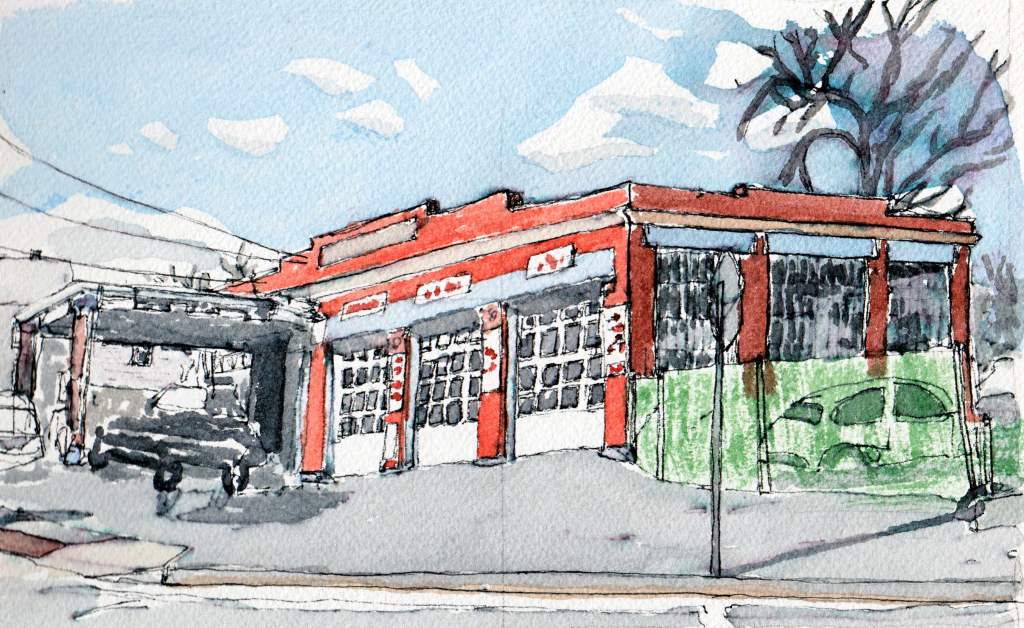
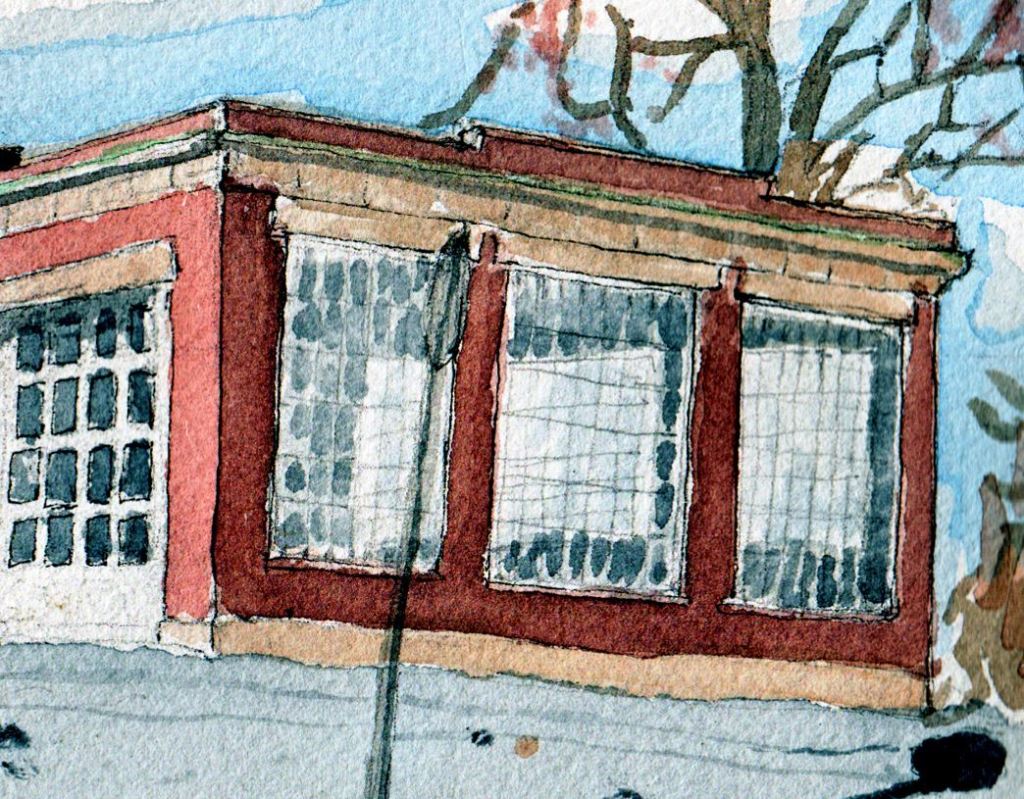
I often noticed this gas station built in 1929 at the corner of Commercial and Front Street in East Braintree, “Wynots Service Station”.
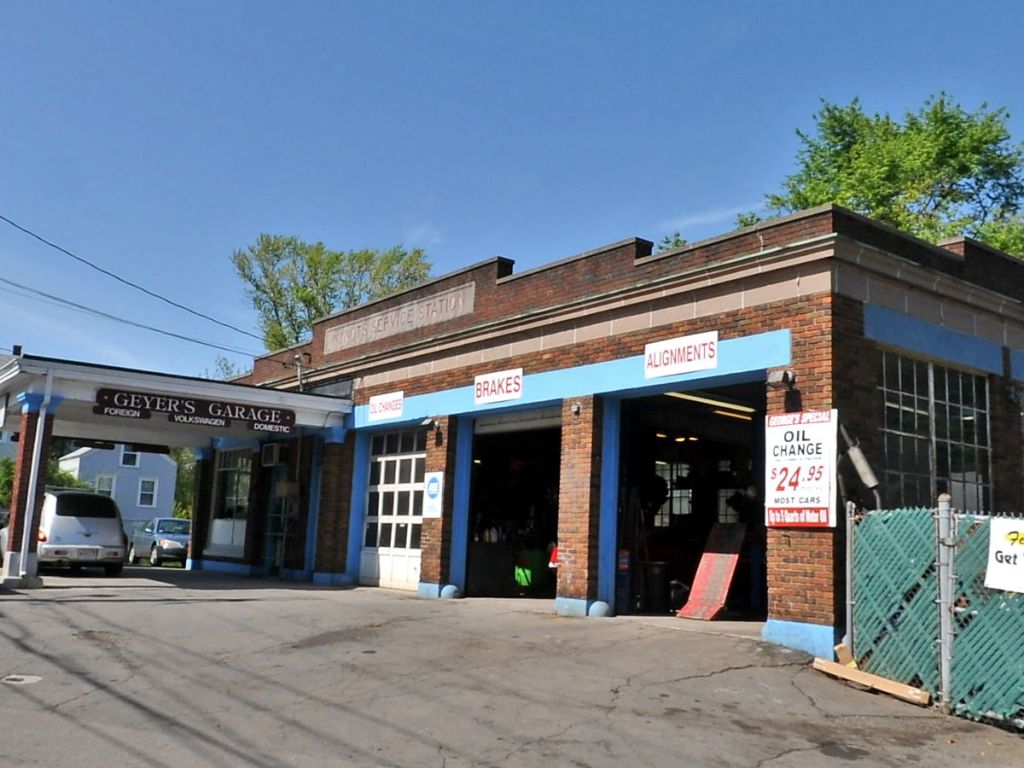
A few times I pedalled my bicycle up from Hingham and sketched it:
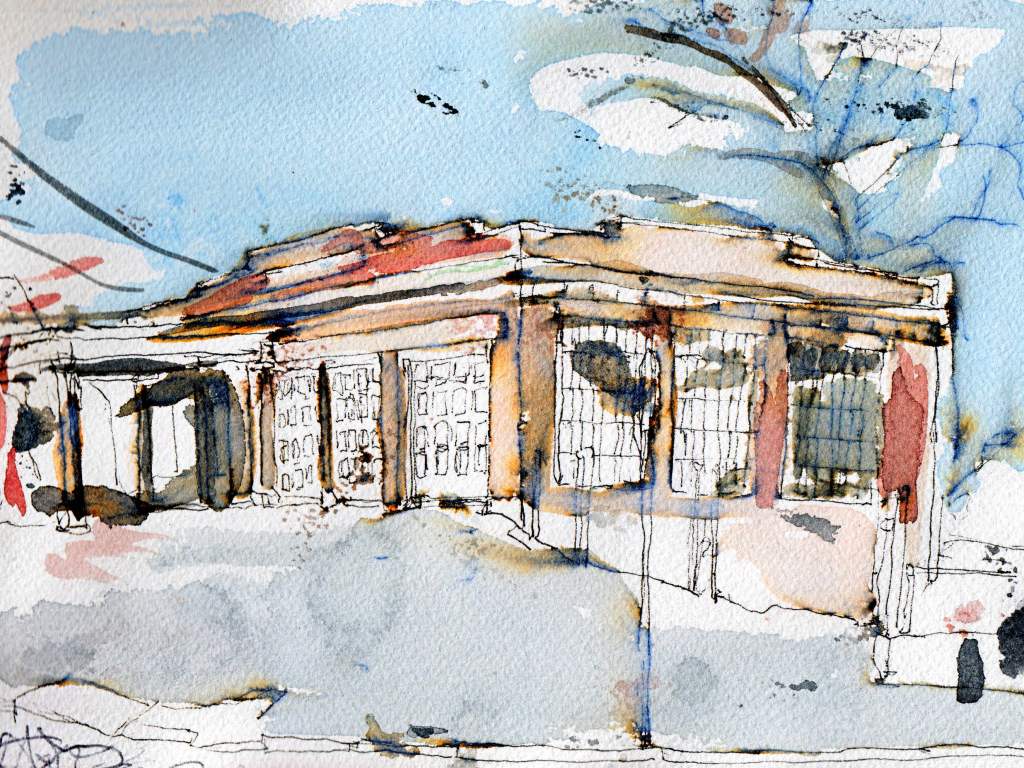
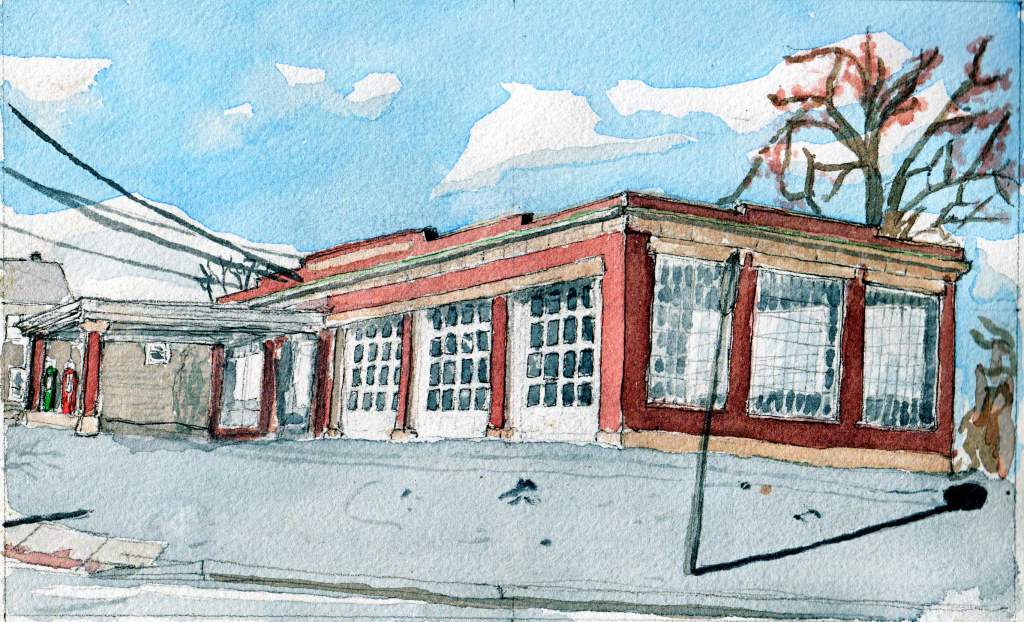
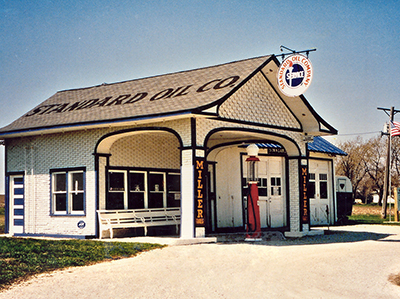
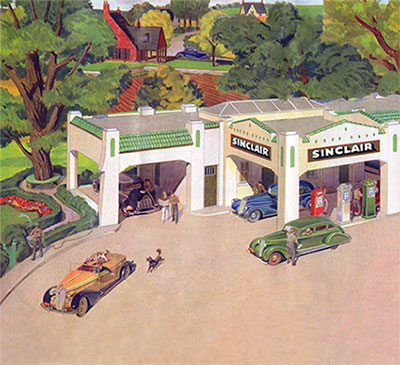
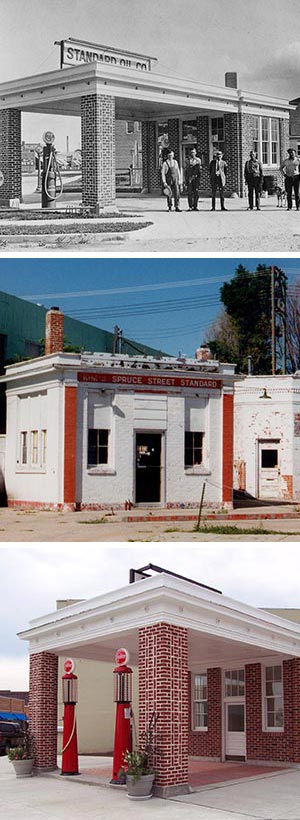
It seemed to connect with the past, the early days of automobiles. When I searched the web for vintage gas stations I found that, sure enough, the U.S. National Park Service offers an entire “Preservation Brief” on “The Preservation and Reuse of Historic Gas Stations. (46)” . The Park Service considers [gas stations] “… a reflection of car culture, pop culture, corporate standardization, and an era of customer service that today seems quaint.” The Preservation Brief’s photographs of restored service stations, following, show the range, including one with the same brick columned canopy as Wynot’s.
But Wynot’s wall to wall windows struck me as the structure’s defining element. They reflected the much larger factory buildings of the period in miniature.
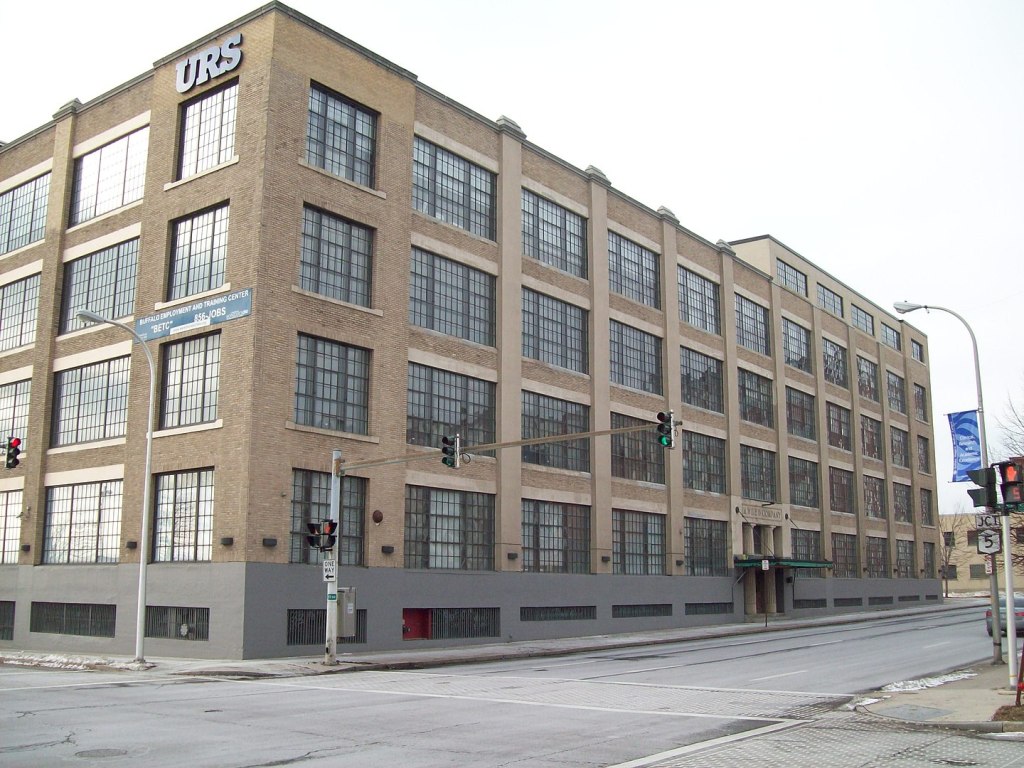
This window wall style dates from the early 1900’s as concrete was replacing conventional wood and brick or steel for constructing the large factories of the “automobile” age.
Albert Kahn b 1869, and his younger brother Julius b. 1874 emigrated from Rhaunen, Prussia as children with their Jewish family to Detroit in 1880. Albert became an architect and supported Julius’ attaining a Civil Engineering degree at the University of Michigan.

http://global.britannica.com/biography/Albert-Kahn
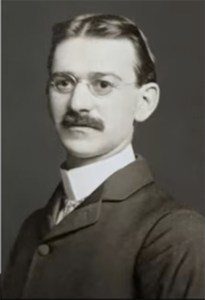
By MMickiewicz – Own work, CC BY-SA 4.0, https://commons.wikimedia.org/w/index.php?curid=112364543
In 1903 Julius, after work with the Army Corps of Engineers, developed a novel scientific method of reinforcing concrete trusses with steel.
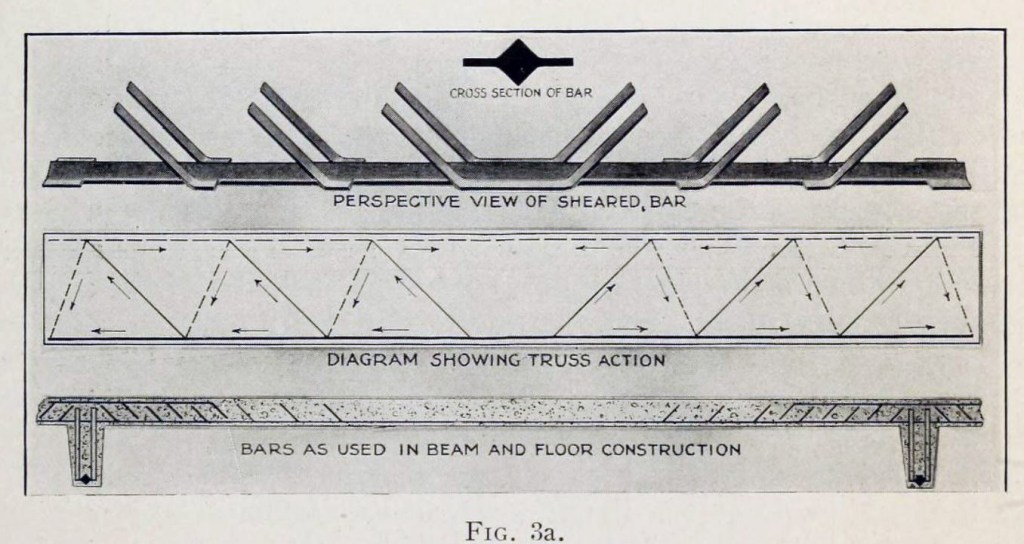
The innovation made reinforced concrete construction practical and allowed for much larger open spaces with higher load bearing limits than conventional wood /brick construction.
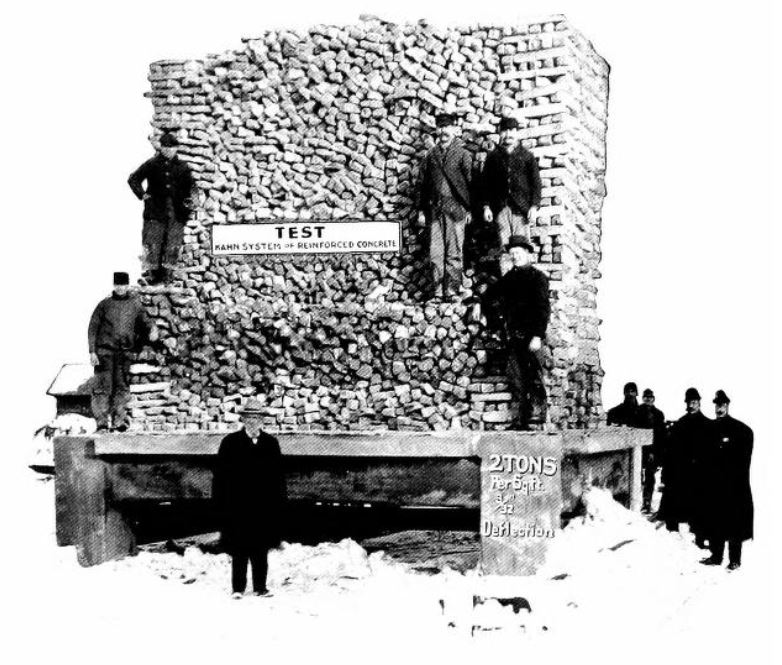
by Truscon Steel Company
It was also less expensive then steel beam construction and was fireproof. As noted in Wikipedia, “In 1906, most of the buildings that survived the San Francisco earthquake and the aftermath fire were those built with the Kahn system by the Trussed Concrete Steel Company.”
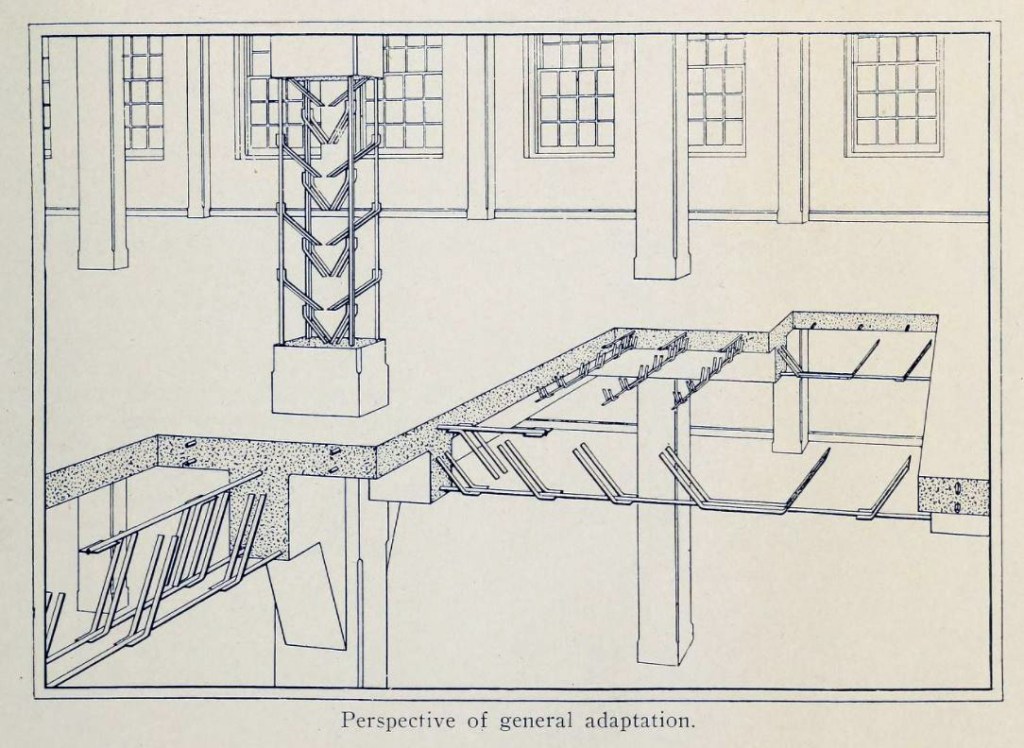

Source Architect Albert Kahn: Buildings & Gardens. Study.com.
Julius and Albert teamed to construct hundreds of buildings using the Kahn System, particularly automobile factories.
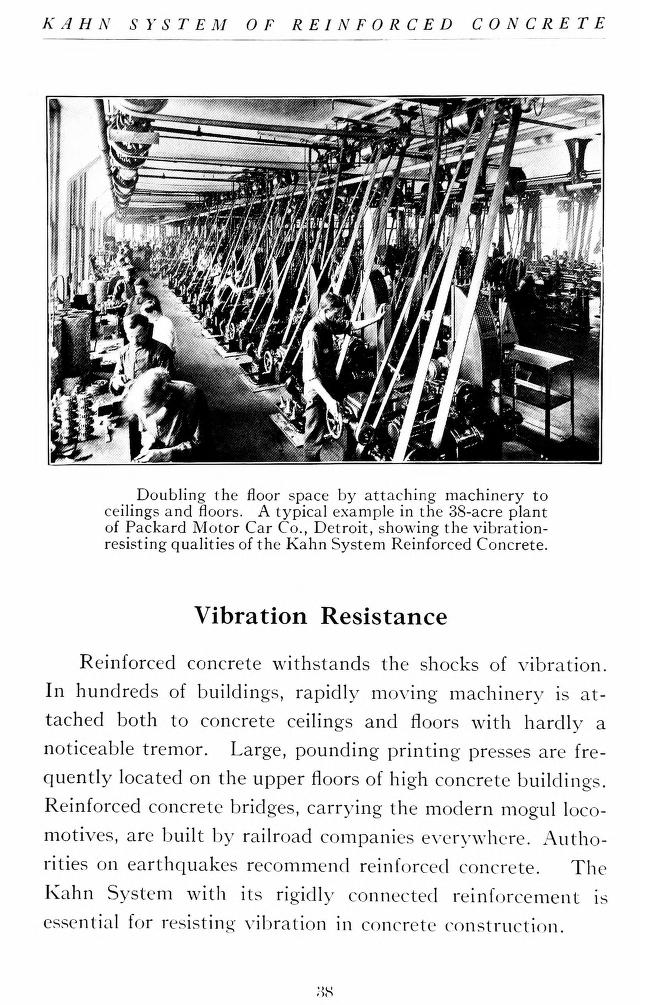
Because floors rested on reinforced concrete pillars rather than load bearing walls with studs and columns, the exterior walls were relatively open allowing the placement of very large, simple steel sash windows floor to ceiling – light admitting windows – hence the term “daylight factories”.
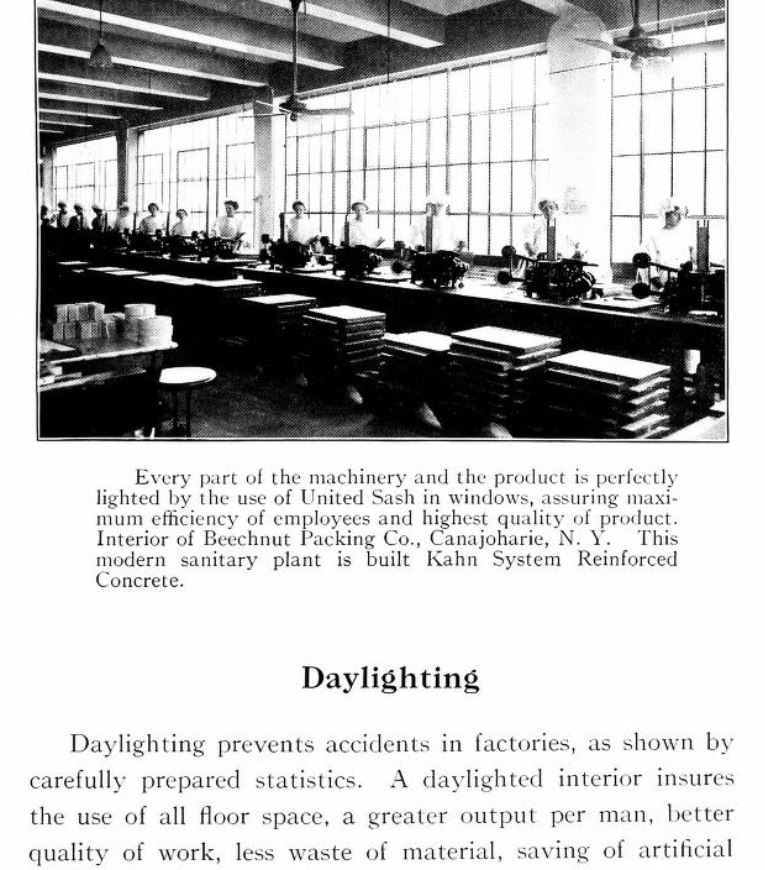
Julius Kahn also established the United Steel Sash Company to supply them.
Wynot’s large steel sash windows were / are “key character-defining features of the structure that should be preserved.”
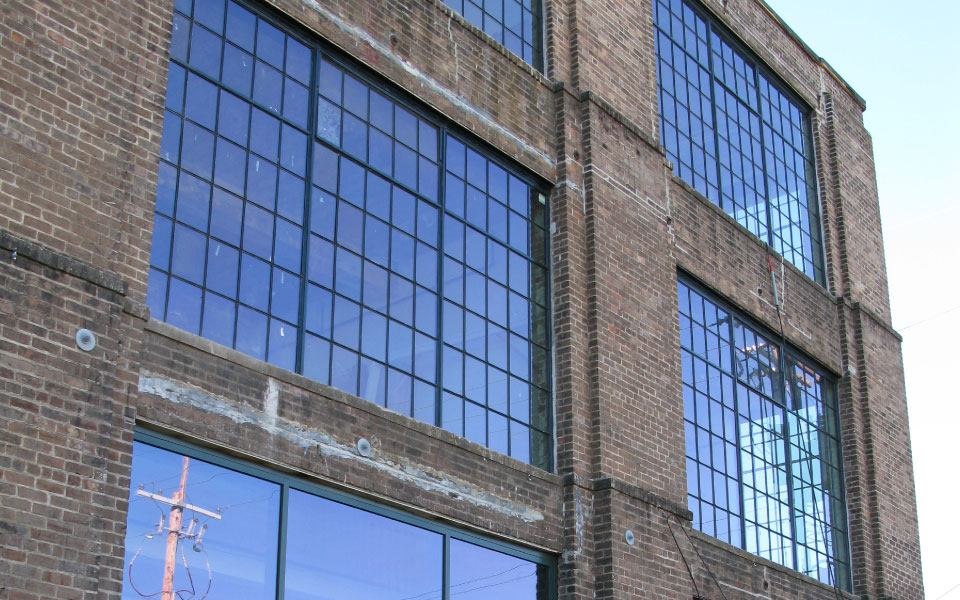
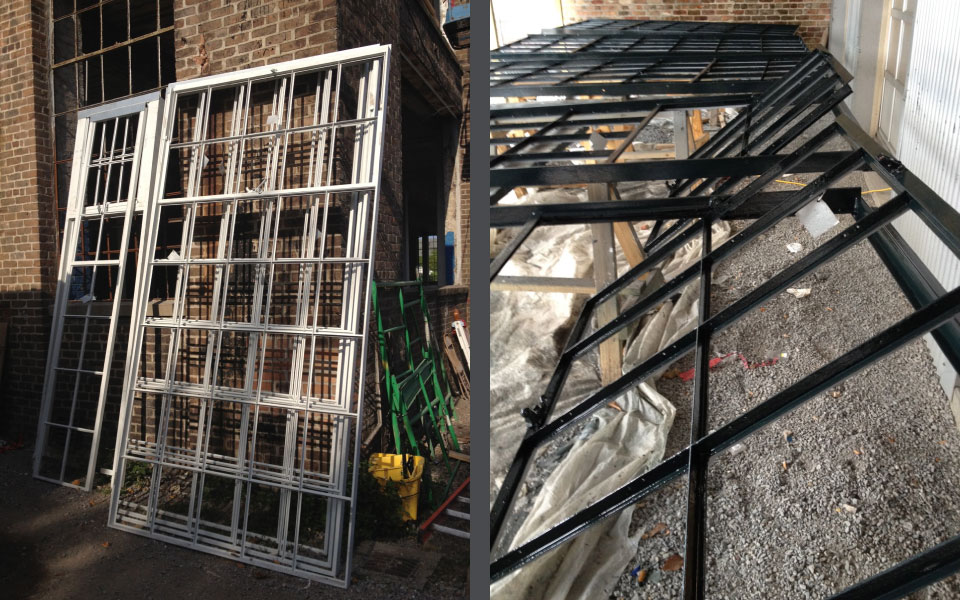
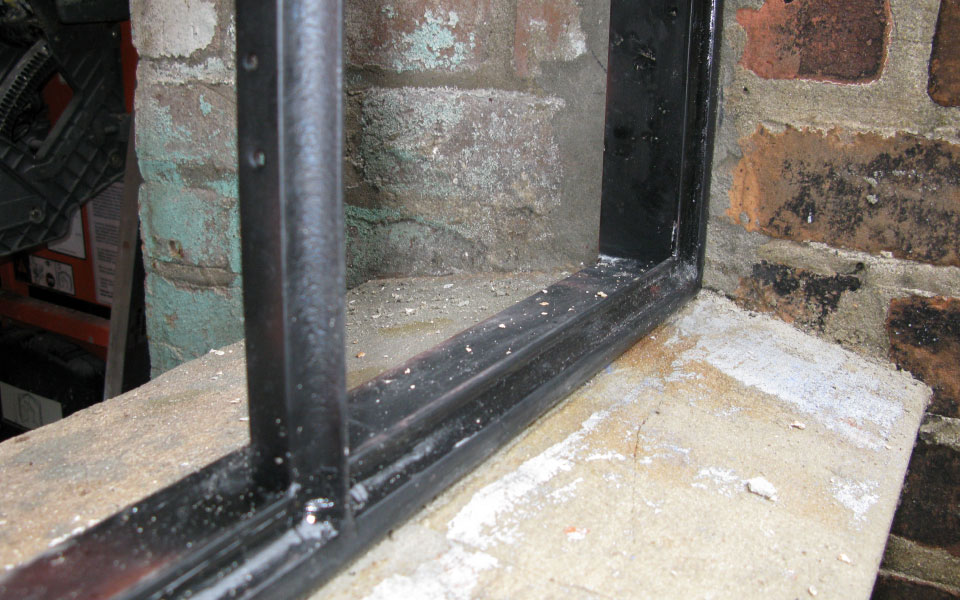
And preserving and updating such windows can prove difficult and costly – but worth it. Removing and sealing any rust, upgrading the glass to offer more thermal comfort and impact resistance adding shades etc. Images from the 511 Marigny project of Studio WTA follow.

Tragically 5 years after I sketched these pictures a new owner purchased the property and “updated” it by totally blocking out each of the windows!!
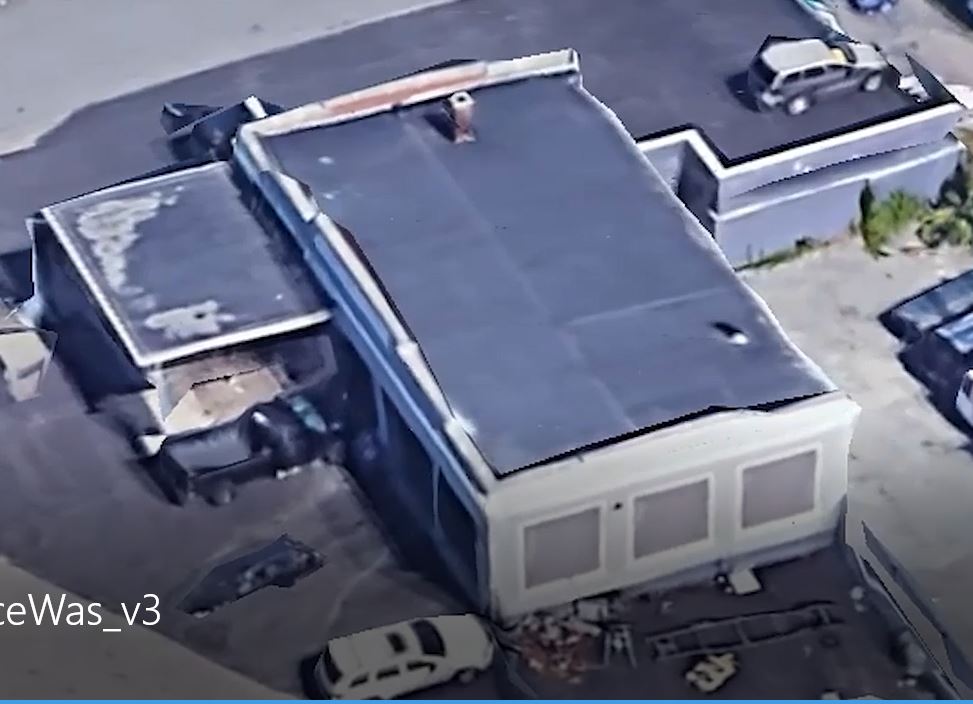
It may still be possible to restore and upgrade these historic steel windows an important character-defining element of a building. Historic tax credits, once factored into the equation, can overcome the higher costs. Restoration would also keep discarded materials out of the landfill, contribute immensely to the authenticity of the building where these windows make up over 50% of the façade. Maybe they are still there underneath the cover?
Video Version of the post:
References:
Albert Kahn (architect). (2003, December 9). Wikipedia, the free encyclopedia. Retrieved February 23, 2022, from https://en.wikipedia.org/wiki/Albert_Kahn_(architect)
Incentives a guide to the federal historic preservation tax incentives program for income-producing properties. Application basics topic: Defining terms. (2004, March 18). NPS.gov (U.S. National Park Service). https://www.nps.gov/tps/tax-incentives/incentives/application_1.htm
“key character-defining features of the structure that should be preserved.”
Jacobs, B. (2013, March 22). Case Study: 511 Marigny Historic Steel Window Restoration. studioWTA | architecture, planning, interiors. Retrieved February 17, 2022, from https://studiowta.com/511-marigny-a-case-study-in-historic-steel-window-restoration/
Powerful story of what is involved in restoring these window walls with compelling pictures – daylight windows.
Juliao, D. (2017, December 22). Architect Albert Kahn: Buildings & Gardens. Study.com. Retrieved February 17, 2022, from https://study.com/academy/lesson/architect-albert-kahn-buildings-gardens.html#:~:text=The%20work%20of%20Albert%20Kahn,by%20creating%20large%20unobstructed%20areas
Kahn was a leader in reinforced concrete trusses for open factory floor plans. Good overview. Used picture of Ford Assembly plant interior from Cleveland OH
Kahn System of Reinforced Concrete : Trussed Concrete Steel Company. [old catalog] :. (1904, June 20). Internet Archive – Library of Congress. Retrieved February 17, 2022, from https://archive.org/details/kahnsystemofrein00trus/page/10/mode/2up?view=theater
Source of Kahn Figures 2 and 3
Kahn system standards : A handbook on reinforced concrete 5th Edition: Trussed Concrete Steel Company. (1913). Internet Archive. Retrieved February 17, 2022, from https://archive.org/details/cu31924015414695/page/n15/mode/2up
Kowsky, F. R. (2000). M. Wile Factory – Statement of Significance for the draft of the nomination to the National Register of Historic Places. Buffalo Architecture and History. Retrieved February 25, 2022, from https://buffaloah.com/a/goodell/77/signif.html
P (Nick P), N. (2020, February). Concrete vs steel: What you need to know. Leading Pre-Construction Service Providers in California. Retrieved February 24, 2022, from https://designeverest.com/lounge/article/concrete-vs-steel-what-you-need-to-know
Pubdog. (2009, December). M. Wile and Company Factory Building. Public Domain, https://commons.wikimedia.org/w/index.php?curid=10183027. Retrieved February 18, 2022, from https://en.wikipedia.org/wiki/M._Wile_and_Company_Factory_Building#/media/File:M._Wile_and_Company_Factory_Building_Dec_09.JPG
Example of reinforced concrete daylighted factory
Randall, C. (2008, September). Preservation brief 46: The preservation and reuse of historic gas stations. NPS.gov (U.S. National Park Service). Retrieved February 18, 2022, from https://www.nps.gov/tps/how-to-preserve/briefs/46-gas-stations.htm
The historic significance of historic gas stations
Salmon, R., & Elliott, M. (2013, April). Structure magazine | The Kahn system of reinforced concrete. STRUCTURE magazine |. Retrieved February 17, 2022, from https://www.structuremag.org/?p=401
Especially, Figure 1: Illustration of cross-sectional and perspective views of the Kahn reinforcement bar, along with a diagram of the theoretical “truss action”. and Figure 2: Illustration of Kahn’s reinforcement as installed in floors, beams and columns.
Trussed concrete steel company. (2014, July 30). Wikipedia, the free encyclopedia. Retrieved February 24, 2022, from https://en.wikipedia.org/wiki/Trussed_Concrete_Steel_Company
“In 1906, most of the buildings that survived the San Francisco earthquake and the aftermath fire were those built with the Kahn system by the Trussed Concrete Steel Company.” Estes, Lewis Alden (1911). Earthquake-Proof Construction: A Discussion of the Effects of Earthquakes on Building Construction with Special Reference to Structures of Reinforced Concrete. Trussed Concrete Steel Co.
United steel sash: Fifth edition : Trussed concrete steel company. (1912). Internet Archive. https://archive.org/details/UnitedSteelSashFifthEdition/page/n11/mode/2up
 Here's What I Found
